Body doubling for mornings: how it works for waking up
Body doubling means doing a task while someone is present. It helps with getting out of bed too. What the research says, and how to set one up.
Key takeaways
- Body doubling means doing a task while someone else is present; the other person doesn't help, they're just there.
- A double can be remote and a stranger, so it doesn't have to be someone in your room.
- The evidence is early and small: a 220-person survey and a 12-person virtual reality study.
- Mornings are the hardest place to find a double, because at 6:45 AM nobody's usual double is free.
- It doesn't work for everyone; if you need to be alone, a solo mission alarm is the better fit.
On this page 8 sections
Body doubling means doing a task while someone else is present, and it works for getting out of bed too: one participant in a 2024 study said they “frequently don’t manage to get out of bed and get breakfast until a body-double is available.” Alarm Mate, an iPhone alarm app, puts a body double at your alarm minute.
That quote comes from participant P106 in a peer-reviewed study of body doubling. It’s the most precise description of the morning problem I’ve found anywhere: everything is possible, once someone is there.
This post is about making someone be there at 7:00.
What body doubling is
Cleveland Clinic’s one-line version:
“Body doubling means you’re doing a task or project while in the presence of one (or more) people”
The other person doesn’t help with the task. They’re just there.
The 2024 study by Eagle, Baltaxe-Admony and Ringland gives the definition its participants use: “using the presence of others to start, stay focused on, or accomplish a task” (Eagle et al., 2024). And, usefully, a double “can be collocated or remote, recorded or live, known or a stranger”.
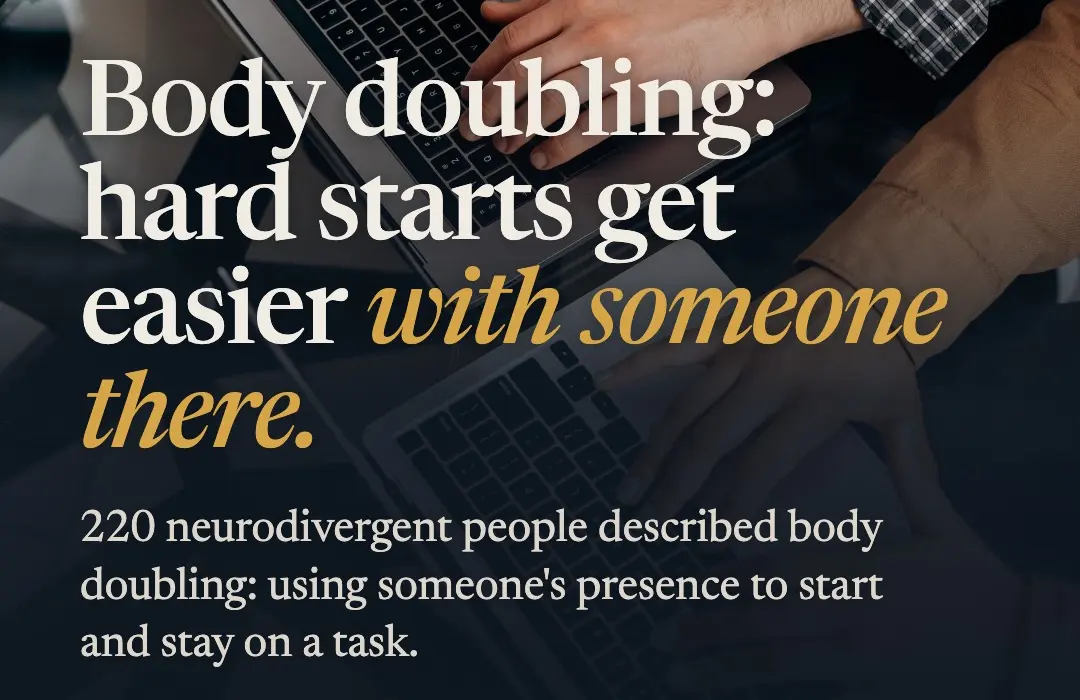
That last line matters for mornings. Your body double doesn’t have to be in your room, and doesn’t have to be your best friend.
Why having someone there works
Cleveland Clinic’s explanation, from Michael Manos, PhD, comes down to three things:
- Executive function. The other person supports the planning-and-starting machinery that tends to stall.
- Example. You pick up their behavior by watching it.
- Attention. Their presence pulls your attention back to the task when it drifts.
Getting out of bed is almost pure starting. There’s no skill involved and nothing to plan, just a first move you keep not making.
That’s why we think doubling fits mornings better than almost any other task.
What the research says, and doesn’t
Honest summary: early, small, and promising. There are two studies worth knowing.
The second study moved the double into a headset.
That’s the whole evidence base for now. The strongest evidence is still lived experience, like this line from an r/ADHDers thread:
“When my friend FaceTimes me, that’s when I feel like doing the dishes that’ve been piling up for a week”
Why mornings are the hardest place to find a double
The Eagle paper noticed something that explains the whole morning problem: people’s usual body doubles often aren’t available because of scheduling.
Now think about 6:45 AM. Your roommate is asleep, and so is the friend who FaceTimes you through the dishes. The online co-working sessions you use for deep work start after you’re already up.
The one task where you most need someone there, getting out of bed, is the one where nobody’s free. That’s the gap. Not motivation, not willpower, not the wrong alarm sound: logistics.

Three ways to get a morning double
1. A friend on FaceTime
Free and warm. Also fragile: it needs one of you to be awake enough to call, and a friend who is up at the same time every day. Great while it lasts.
2. A co-working session
Focus-session sites and co-working calls work well for body doubling, and some now run morning slots: Flow Club has “Start Your Day” sessions, and Focused even has one called “Wake-Up Call”. But a session is something you join, so you have to be up already.
Focused pitches its Wake-Up Call as a time to set goals for the day, not a way out of bed. These help most once you’re vertical and caffeinated, which is exactly when you need them least.
3. An alarm with a person attached
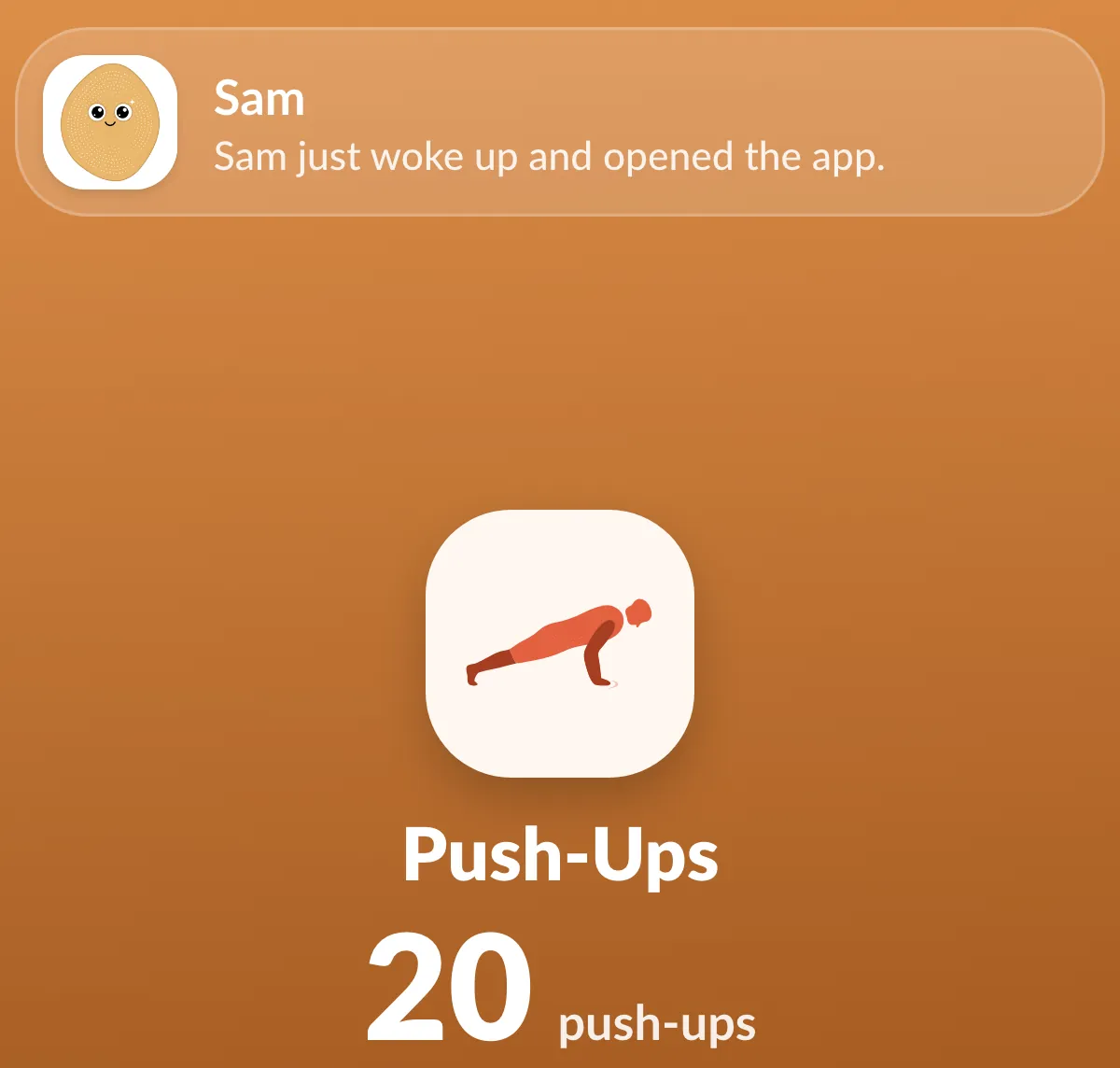
This is what we built into Alarm Mate, the idea behind a social alarm. You get matched with a buddy whose alarm rings the same minute as yours.
When it goes off, you can see what they’re doing, live: “Sam just woke up and opened the app.” Then: “Sam is doing Push-Ups: 12 push-ups so far.” You’re not alone at 6:45 anymore, and neither are they.
The double arrives with the alarm, before you’re up, which is the one moment the other two options can’t cover. The full minute-by-minute is in waking up with a buddy, minute by minute, and why it only works if they show up is in the reliability post.
When it doesn’t help
Body doubling isn’t universal, and pretending it is helps nobody. From the same Reddit thread as the FaceTime quote:
“No, sadly it’s never worked for me… I basically have to be alone to be productive.”
If that’s you, fine. You might do better with an alarm that asks something of your body or brain and leaves other people out of it. Solo alarms and every mission on Alarm Mate are free; see alarm missions explained.
If the problem is less about motivation and more about switching the alarm off in your sleep, see why you turn off your alarm and don’t remember it.
Setting up your first doubled morning
- Pick one exact minute. Body doubling at “around seven” doesn’t work. Pick 7:00 and stick to it for a week; Match pairs you with someone at that same minute.
- Choose a mission you can do while watching their status. Something that gets you up, like Walk Away from Bed or push-ups, pairs well with glancing at your buddy’s progress.
- Tap “Wait for Sam” if you want to start together. If they’re still waking up, you can wait for them in the lobby and start at the same moment. Or tap “Start now” and let them catch you.
- Keep the chat short. When you’re both up you’ll see “You’re both here. Say good morning.” Say it. The chat closes 15 minutes after the alarm time, which is the right length for “morning, you alive?”
Want a body double at your alarm minute? Alarm Mate is on the App Store.
FAQ
Does a body double have to be someone I know?
No. The study’s own definition says a double can be “known or a stranger”, so a wake-up buddy you’ve just met counts.
Does it work over a phone, not in person?
Yes, that’s included in the definition too: a double “can be collocated or remote”. A friend on FaceTime or a buddy’s live status on your screen both count as remote.
Sources
- Eagle, Baltaxe-Admony and Ringland. “‘It Was Something I Naturally Found Worked and Heard About Later’: An Investigation of Body Doubling with Neurodivergent Participants.” ACM Transactions on Accessible Computing 17, no. 3 (2024). dl.acm.org
- Cleveland Clinic. “How Body Doubling Helps With ADHD.” 6 January 2025. health.clevelandclinic.org
- Ara Z, Bin Rahim I, Zhou P, et al. “You Are Not Alone: Designing Body Doubling for ADHD in Virtual Reality.” arXiv:2509.12153 (2025). arxiv.org
- Reddit thread quoted: r/ADHDers 1u337ts
Related posts
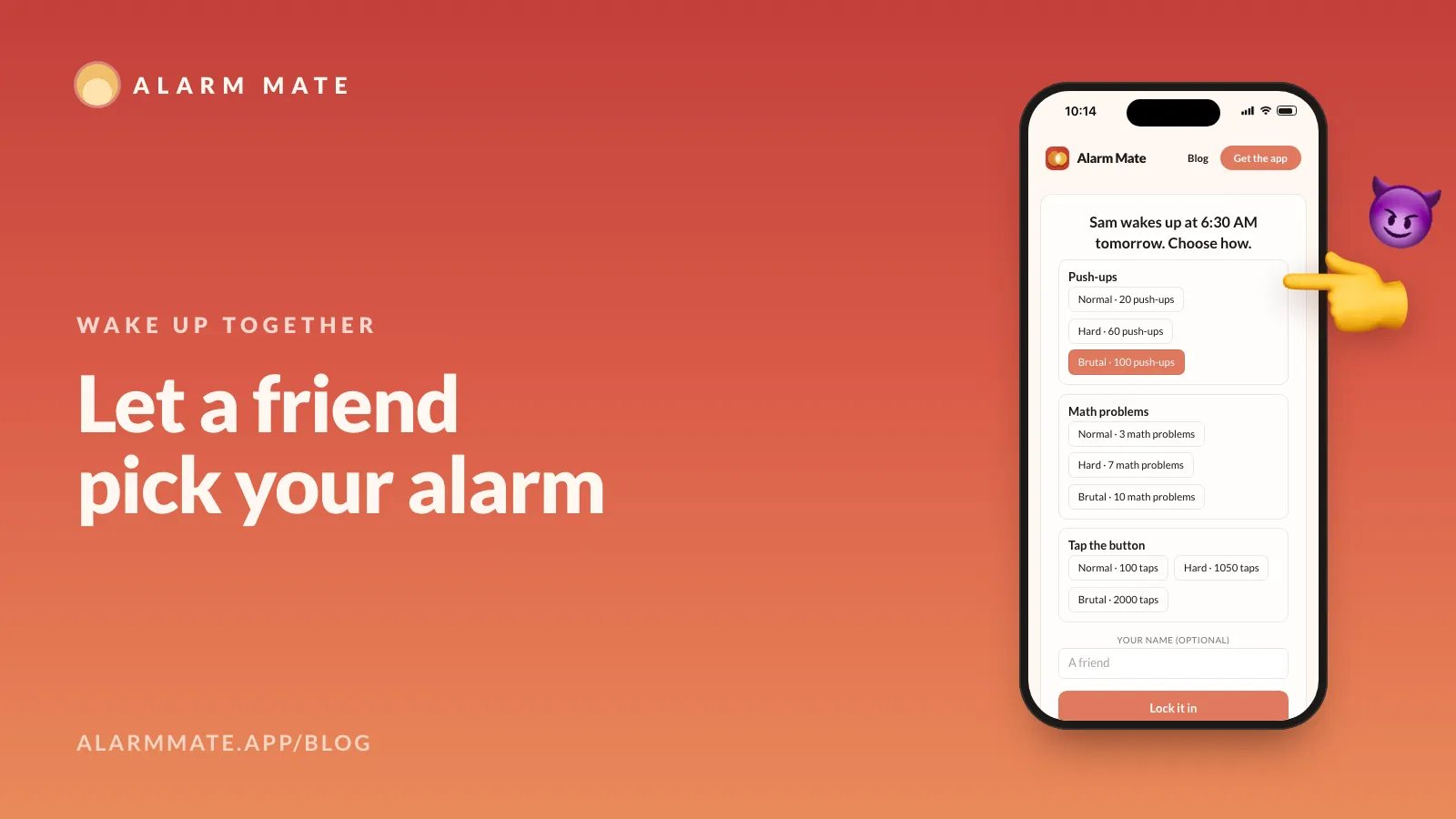
Let a friend pick your alarm (they'll choose 100 push-ups)
Share a link and a friend picks your wake-up mission and how hard: Normal, Hard or Brutal. They don't need the app. You find out when it rings.
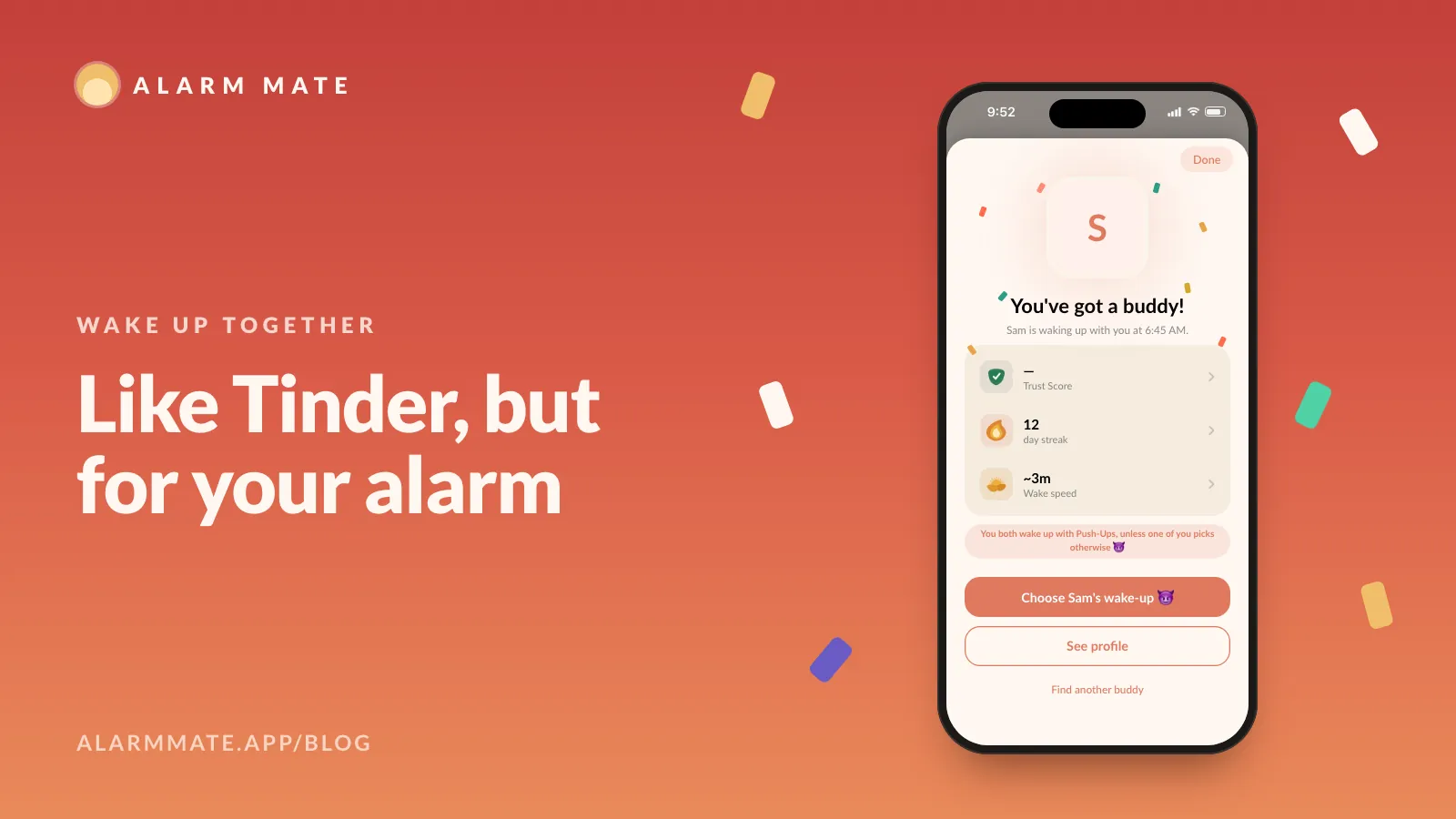
Like Tinder, but for your alarm (not for dating)
Set an alarm and get matched 1-on-1 with someone whose alarm rings the same minute. It borrows the match screen from dating apps, and nothing else.
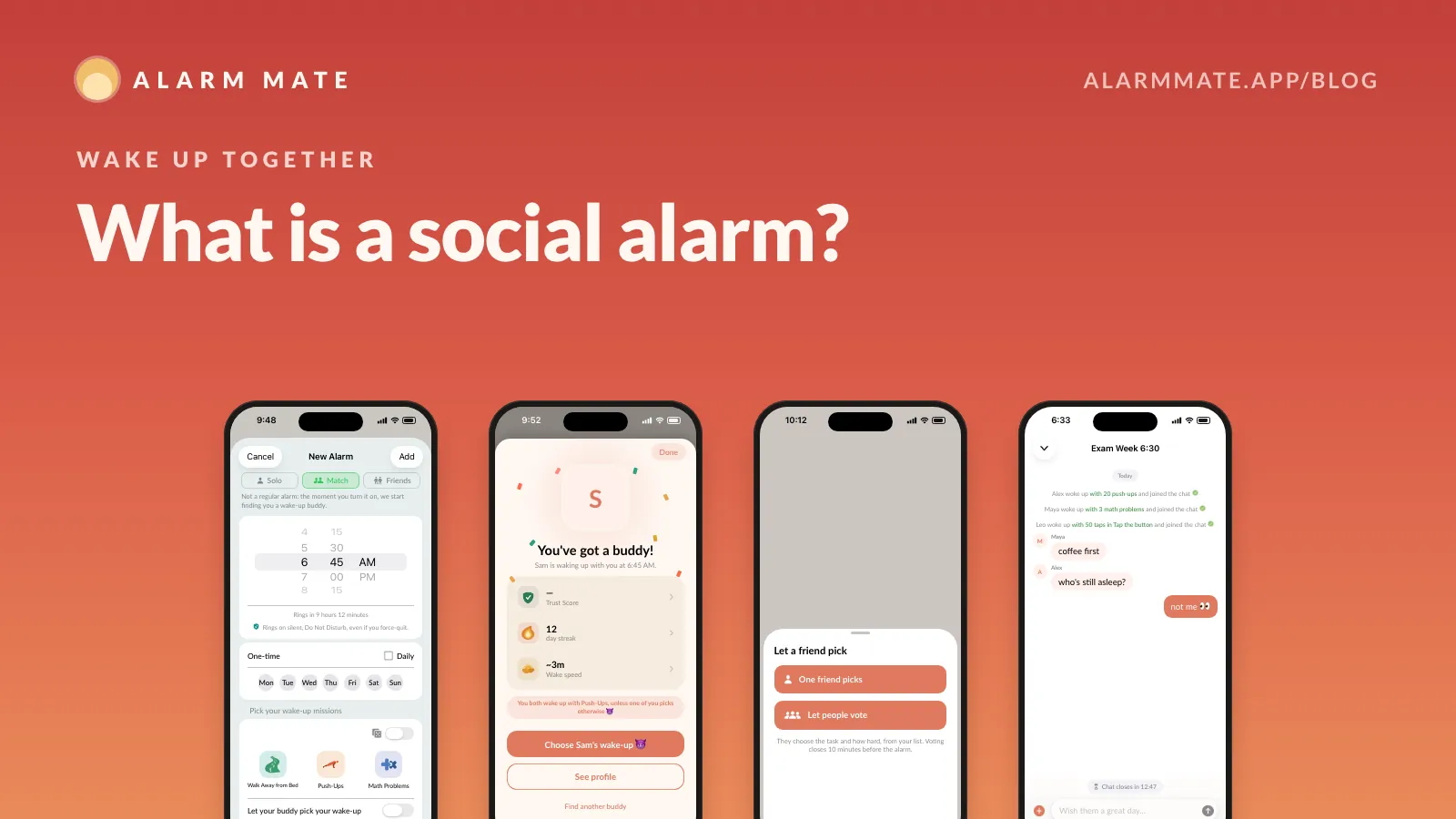
What is a social alarm? Why we built the first one
A social alarm wakes you up with other people: a buddy at the same minute, friends who pick your mission, groups that ring together. How it works.
Tomorrow morning, don't do it alone.
Alarm Mate is on the App Store for iPhone. Solo alarms are free, and so is every mission.