Why you turn off your alarm and don't remember it
You probably did wake up. A 1997 sleep study shows how the memory can vanish when you fall back asleep, and which alarm tasks keep you up long enough.
Key takeaways
- You probably did wake up: switching off an alarm only takes a few half-awake seconds.
- In a 1997 sleep study, people woken after 10 minutes of sleep had profound trouble recalling the four minutes before they fell asleep.
- A louder alarm or several alarms fail the ten-minute test: each is one quick tap, then another short sleep.
- A task that keeps you up for a few minutes gives the fog time to lift; a random pick stops autopilot from learning it.
- If it happens most mornings despite enough sleep, or affects work, school or driving, talk to a clinician.
On this page 10 sections
You probably did wake up. Switching off an alarm takes a few half-awake seconds, and a 1997 sleep study suggests that if you fall back asleep soon after, the memory of those minutes can be lost. Alarm Mate is an iOS alarm app that makes you finish a task, like math or a color test, before the alarm stops.
“Anyone else turns off their alarm with zero memory of doing it?” That question got 1,307 upvotes on r/GetStudying, which tells you roughly how many people are waking up at 9:40 to an alarm that “never went off”. Another person described the same state from the inside:
“my eyes can be open and I can be in a whole conversation but I won’t remember any of it”
You’re not lazy, and your phone isn’t haunted. This is how a sleeping brain handles memory, and once you see the mechanism, most of the usual fixes look a little different.
The memory you made, then lost
The last few minutes before sleep can get lost once sleep takes hold. The paper that showed it calls this mesograde amnesia, right in its title.
Now apply that to your morning. You surface, silence the alarm, and slide back under within a minute or two. Ten minutes of sleep later, the memory of those minutes may simply not have survived.
You did wake up. You just didn’t keep the receipt.
A fair caveat: Wyatt’s study was about falling asleep at night with words played in a lab, not about alarms. The link to your alarm is our reading of it. The study suggests the mechanism; it doesn’t prove that’s what happens in your bedroom.
Never written down, or written and wiped?
Most explanations you’ll find online stop at grogginess: right after waking, the parts of your brain that store memories are still slow, so the tap happens and nothing gets recorded. That’s plausible, and it’s probably part of the story.
Wyatt points at a second route, and it changes the fix. Even a memory that did form can be wiped if you fall back asleep within minutes. The two routes ask for different answers:
- If you were only too groggy to record the tap, the fix is to be more awake during it: a louder sound, a harder button.
- If you fell back asleep and lost what you did, the fix is to stay up after it. How awake you were for those two seconds matters less than what happens in the next ten minutes.
Most alarm advice is aimed at the first route. The second one is the one an alarm can actually do something about.
The grogginess is real too
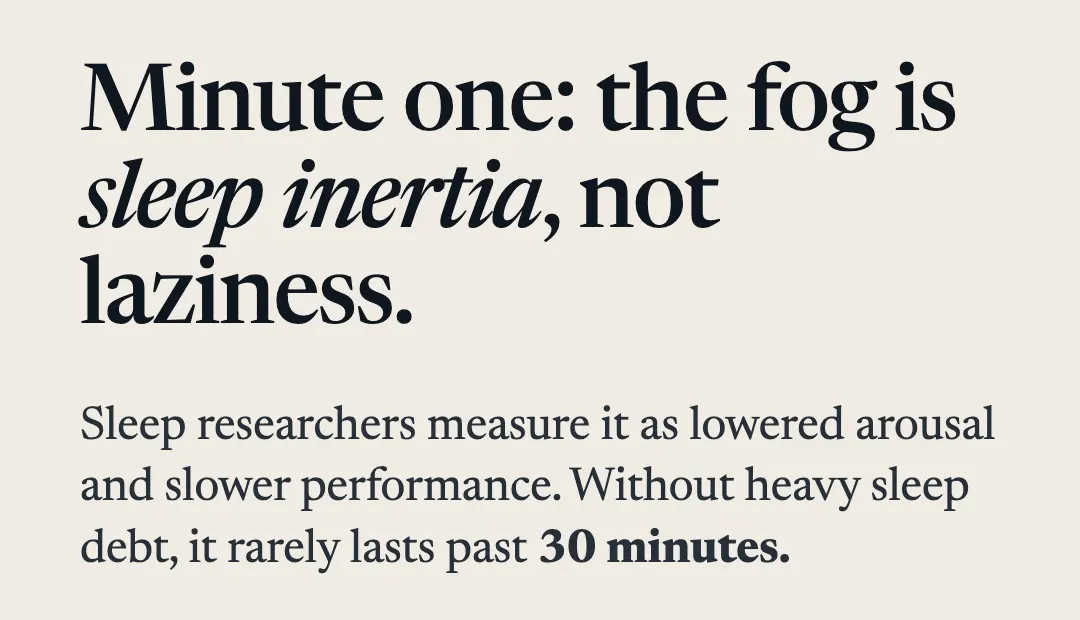
None of this makes grogginess a myth. The first minutes after waking come with sleep inertia: you’re awake, but slower and sleepier and worse at thinking than you’ll be shortly after.
| Review | What it says |
|---|---|
| Hilditch and McHill, 2019 | Clear drops in performance that fade the longer you stay awake, and get worse with too little sleep and at bad times of day |
| Tassi and Muzet, 2000 | Waking out of deep sleep produces the heaviest version; without major sleep deprivation it rarely lasts beyond about 30 minutes |
| Trotti, 2017 | Some features of sleep appear to persist past the point of waking |
“Awake” isn’t a switch. It’s a dimmer, and at 6:30 the dimmer is low.
My interpretation, clearly labelled as one: a single tap or swipe is small enough to fit inside that half-state. You don’t need attention, memory or balance to hit a big button you’ve hit a thousand times.
Put the two halves together and you get the classic morning: a half-awake hand, a short trip back to sleep, and no memory of either.
The ten-minute test for the usual fixes
Hold each popular fix up to one question: does it keep you up long enough that falling back asleep isn’t the next thing that happens?
| Fix | What it changes | Our read |
|---|---|---|
| A louder alarm | You wake up harder | Fails. Switching it off still takes one second, and the pillow is right there. |
| Several alarms, minutes apart | More wake-ups | Fails. Each one is another quick tap, followed by another short sleep. |
| Phone across the room | You have to stand up | Sometimes. The walk takes under a minute, and the bed is on the way back. |
| A task that takes minutes | You stay up and busy | Better odds. This is the idea behind alarm missions. |
The phone across the room is the interesting one. It does get you vertical, which counts for something.
But if you’re back under the duvet 40 seconds later, then by our reading of Wyatt you’re in the same spot as before: ten minutes of sleep can take the walk with it, and you’ll swear you never got up.
What a task changes
A wake-up mission is built to be too big for the half-state and too long for a quick relapse. On Alarm Mate there’s no snooze and the alarm keeps ringing until you finish the mission, so you have to stay with it for a while: read a problem, work out an answer, hit a target count.
The design logic: if the task keeps you up for a few minutes, you’re more likely to still be up when the fog lifts, and less likely to fall straight back asleep and lose the memory.
That’s a reasoned design choice, not a tested claim. No study has tested alarm missions directly. There is one relevant hint:
Thinking tasks aren’t useless, but moving your body may be the stronger lever. We cover that in push-ups at 7 am.
When mind games stop working
Mind missions have a known failure mode: your brain learns them. One r/ADHD user said that after months of math missions they had learned to do arithmetic without actually waking up (r/ADHD). Your autopilot is more talented than you think.
Three ways to stay ahead of it:
- Randomize. Pick several missions and one is drawn at random each morning. You can’t pre-learn a morning you can’t predict.
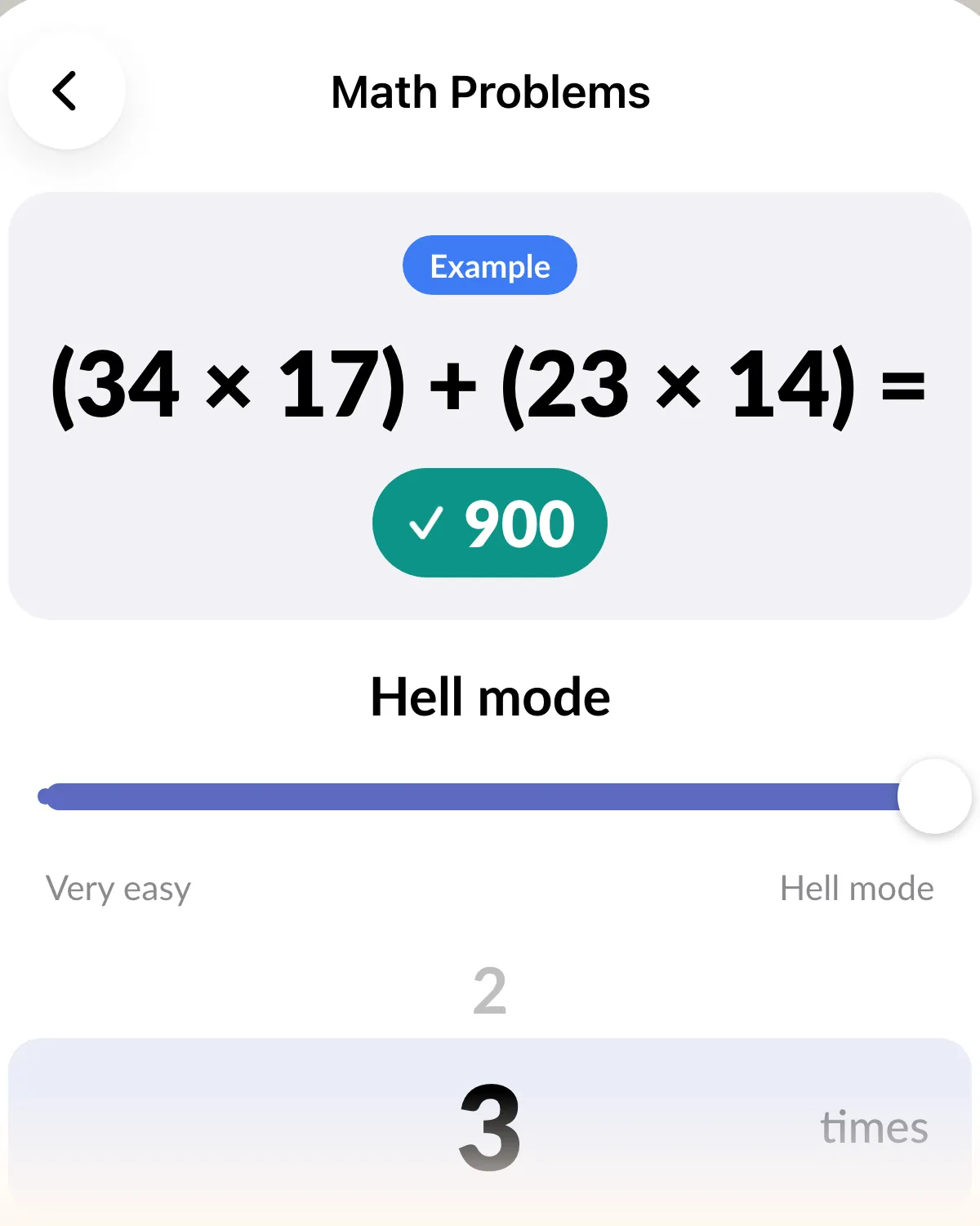
- Vary the dial. Math Problems runs from Very easy to Hell mode across seven tiers, with 1 to 10 problems. Harder is not automatically better (see the FAQ), but a tier that surprises you works better than one you could do in your sleep. Literally.
- Mix in movement. One movement mission in the pool means some mornings you’re on the floor instead of on autopilot.
Mind missions that resist autopilot
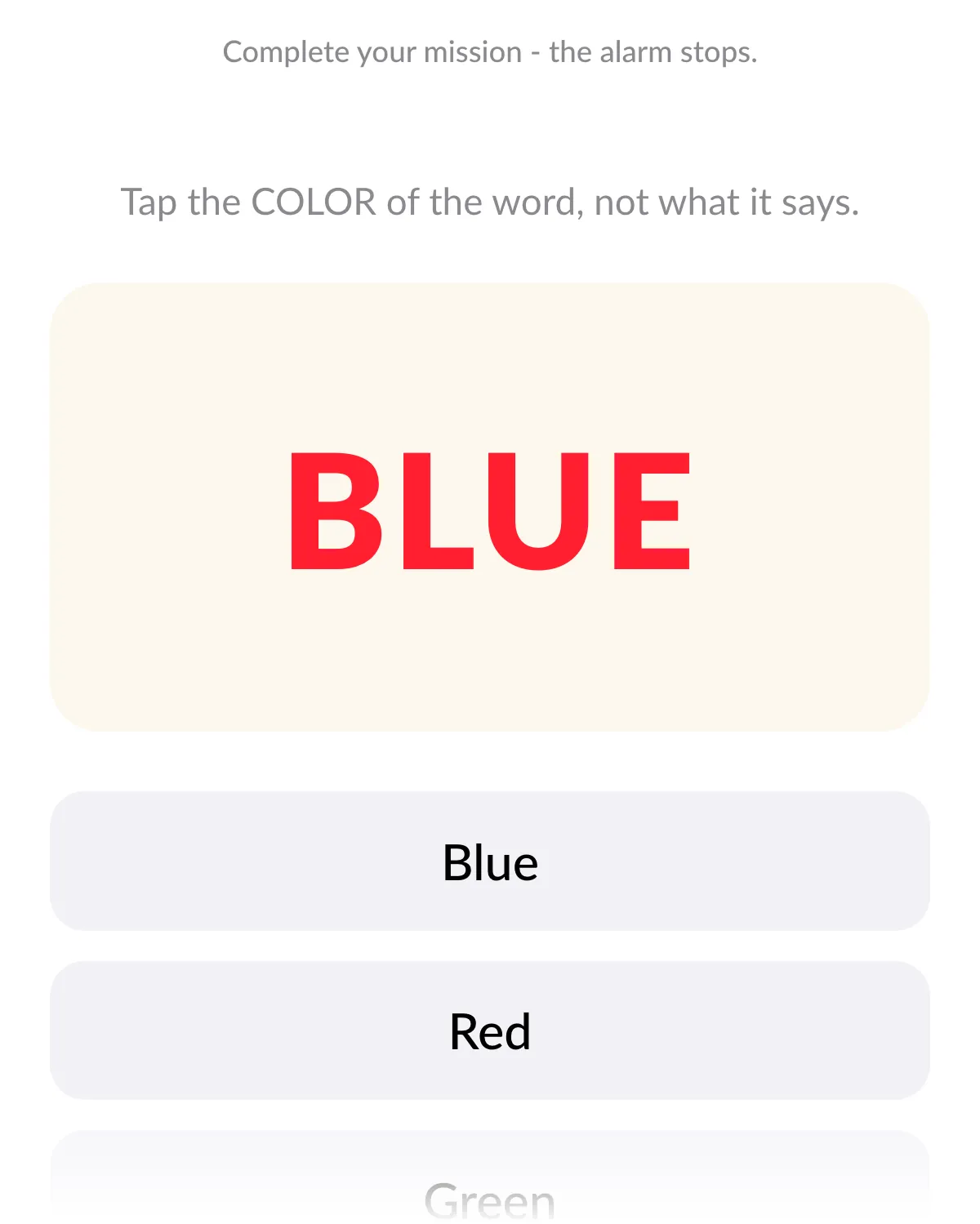
Some mind missions resist autopilot better than others. Tap the Color is a Stroop task: the word names one color and is printed in another, and only the ink counts.
Reading is automatic, so your brain hands you the wrong answer first, and overriding it takes a small act of attention every round.
Swipe Arrows asks for real swipes in the shown direction, 10 to 300 of them. Typing makes you retype a sentence word for word, from five-word Easy lines to Beast sentences past twenty words.
The other fix is a person who notices
A mission can keep you busy. It can’t tell whether you fell back asleep afterwards. A person can.
When you wake up with a buddy on Alarm Mate, you both see each other’s live status. Say you’re Maya and your buddy is Sam: if you’re not moving, Sam sees “Maya is still asleep.”
And if you’re still out, Sam gets one shot at you per morning: holding “RING MAYA’S ALARM” sends you a loud ”🚨 Sam is ringing your alarm!” push. It’s hard to forget a morning when someone else was watching it happen.
What that morning looks like is in waking up with a buddy, minute by minute, and the behavior side of snoozing is in how to stop snoozing when willpower doesn’t work.
When it’s more than a bad morning
Occasional forgotten alarms are normal. But the Trotti review also notes that a more pronounced state of confusion and sleepiness on waking, sometimes called “sleep drunkenness”, is common in hypersomnolence disorders (Trotti, 2017).
If you’d just like an alarm that doesn’t let your thumb decide alone, the whole mission list is in alarm missions explained, every mission is free, and Alarm Mate is on the App Store for iPhone on iOS 26 or later. Why it keeps ringing even when you try to wriggle out is in the alarm you can’t snooze or turn down.
FAQ
How long does grogginess last?
Across studies, sleep inertia has been measured at anything from 1 minute to 4 hours. Without major sleep deprivation, it rarely goes beyond 30 minutes, according to a review by Tassi and Muzet.
Is it normal?
Forgetting that you turned off an alarm now and then is common and fits what sleep research describes. If it happens most mornings despite enough sleep, or comes with heavy confusion, it’s worth talking to a clinician.
Does harder math work better?
Not necessarily. A tier so hard you can’t finish it half-asleep turns the morning into a fight. What seems to matter more is that the task isn’t one you can do on autopilot, so variety and a random pick often beat raw difficulty.
Sources
- Wyatt JK, Bootzin RR, Allen JJ, Anthony JL. “Mesograde amnesia during the sleep onset transition: replication and electrophysiological correlates.” Sleep 20 (1997): 512-522. doi.org/10.1093/sleep/20.7.512
- Hilditch CJ, McHill AW. “Sleep inertia: current insights.” Nature and Science of Sleep 11 (2019): 155-165. doi.org/10.2147/NSS.S188911
- Tassi P, Muzet A. “Sleep inertia.” Sleep Medicine Reviews 4 (2000): 341-353. doi.org/10.1053/smrv.2000.0098
- Trotti LM. “Waking up is the hardest thing I do all day: Sleep inertia and sleep drunkenness.” Sleep Medicine Reviews 35 (2017): 76-84. doi.org/10.1016/j.smrv.2016.08.005
- Beauchamps V, Sauvet F, Boyer S, Nemmi F, Buratto F. “Evaluate the effectiveness of cognitive stimulation and physiological dynamization on sleep inertia.” Frontiers in Physiology 17 (2026): 1855408. doi.org/10.3389/fphys.2026.1855408
- Reddit threads quoted: r/GetStudying 1ste73b, r/adhdwomen 1qticf1, r/ADHD t9251f
Tomorrow morning, don't do it alone.
Alarm Mate is on the App Store for iPhone. Solo alarms are free, and so is every mission.