Push-ups at 7 am: what exercise does to morning grogginess
Two lab studies tested exercise right after waking. One made people feel less sleepy; one also sharpened reactions. What that means for push-up alarms.
Key takeaways
- The fog after waking is called sleep inertia; without major sleep deprivation it rarely lasts more than 30 minutes.
- A 30-second sprint after waking made people feel less sleepy, but their cognitive test scores didn't change (Kovac et al., 2021).
- In a small 2026 trial, five minutes of movement at 07:00 gave faster reactions and fewer lapses 20 minutes after waking.
- Pick a rep count you'll finish half-asleep: ten push-ups done beats 100 set and dreaded.
- Clear floor space before bed, do balance work next to something you can hold, and ask a clinician first if you have a condition.
On this page 9 sections
A short burst of movement after waking can make you feel less groggy, and a small 2026 trial found five minutes of movement sharpened reaction times more consistently than a memory test. It won’t fix too little sleep. Alarm Mate is an iOS alarm app whose push-up, squat and balance missions put that movement before the alarm stops.
One Reddit developer described the moment every push-up alarm is built for:
“Shake the phone? I do it… and go right back to sleep. So I thought… what if the alarm makes it impossible to stay in bed?”
Fair question. Here’s what the lab says about the answer.
What morning grogginess is
The fog after waking has a name: sleep inertia. It’s a short stretch where you’re technically awake but slower, sleepier and worse at thinking than you’ll be half an hour later.
A 2019 review describes clear drops in cognitive performance that fade the longer you stay awake, and that get worse after too little sleep (Hilditch and McHill, 2019).
How long does it last? An older review found anything from 1 minute to 4 hours across studies, but without major sleep deprivation it “rarely exceeds 30 min” (Tassi and Muzet, 2000). Waking out of deep sleep is the worst case.
So the question for a push-up alarm is simple. Does moving during those minutes make them shorter or easier?
Why moving might help at all
The plain version: waking up is partly a physical process. Blood flow and body temperature shift as you come out of sleep, and exercise pushes on some of the same levers.
That’s the case a sleep research group made in a 2020 review, when they argued exercise was worth testing as a fix for sleep inertia (Kovac et al., 2020).
Notice the wording: worth testing.
Some push-up alarm websites list heart rate, core temperature and hormones as if the case were closed. The ones we read don’t cite a single study. Here are the two that exist.
The two studies that tested exercise at wake-up
The first woke people in the middle of the night.
The second is newer, and set at a normal wake-up time.
Feeling awake versus being sharp
Put the two side by side and you get an honest, slightly boring conclusion:
- Movement reliably helps you feel more awake.
- Whether it makes you think better is less settled. One study says no, one small study says yes.
It’s a young line of research, and nobody has tested a push-up alarm directly.
For an alarm, the feeling part is most of the point. The dangerous moment isn’t failing a reaction-time test at 7:04; it’s lying back down at 7:02 because you feel like a wet towel. Anything that moves you past that moment is doing its job.
What the movement missions ask of you
Alarm Mate has three movement missions, and the alarm keeps ringing until the camera has seen you do the work.
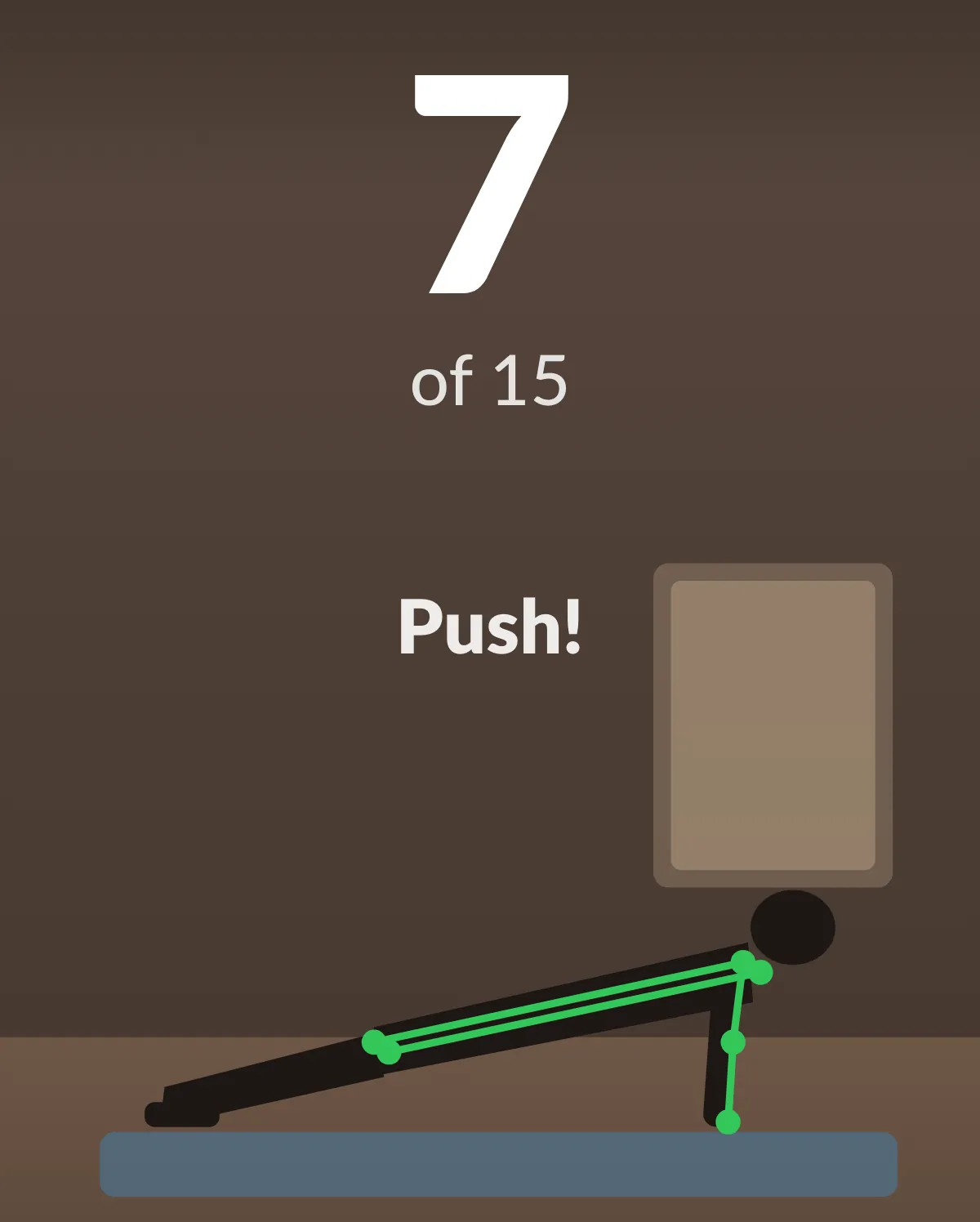
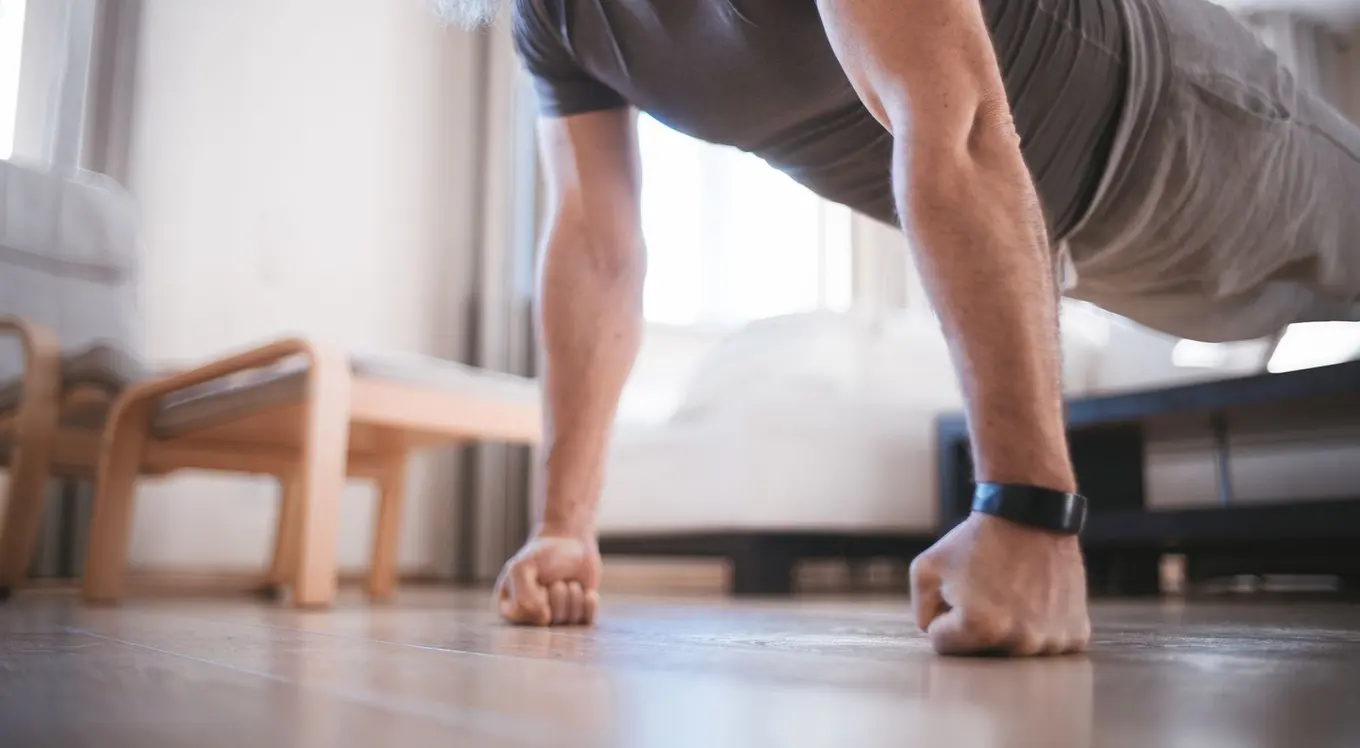
- Push-Ups: 5 to 100 reps, in steps of 5. Prop the phone up, get your whole body in frame, and the front camera counts. Half reps don’t count.
- Squats: 5 to 100 reps, in steps of 5. Phone low on the floor, legs in shot, and your thigh has to get close to horizontal.
- One-Leg Balance: 10 to 60 seconds of hold, in steps of 5. Put your foot down for two full seconds and the clock goes back to zero.
The counting happens on your phone. If you want proof for your friends, these three missions can also record a video of up to 180 seconds that you can choose to post.
Nothing is shared unless you share it.
Every mission is free, including these; see the full list in alarm missions explained.
Pick a number you’ll do half-asleep
The best rep count is the one you’ll finish while groggy and slightly offended. Ten push-ups done beats 100 set and dreaded, and the Beauchamps group got their effect from five minutes of fairly gentle movement, not a workout.
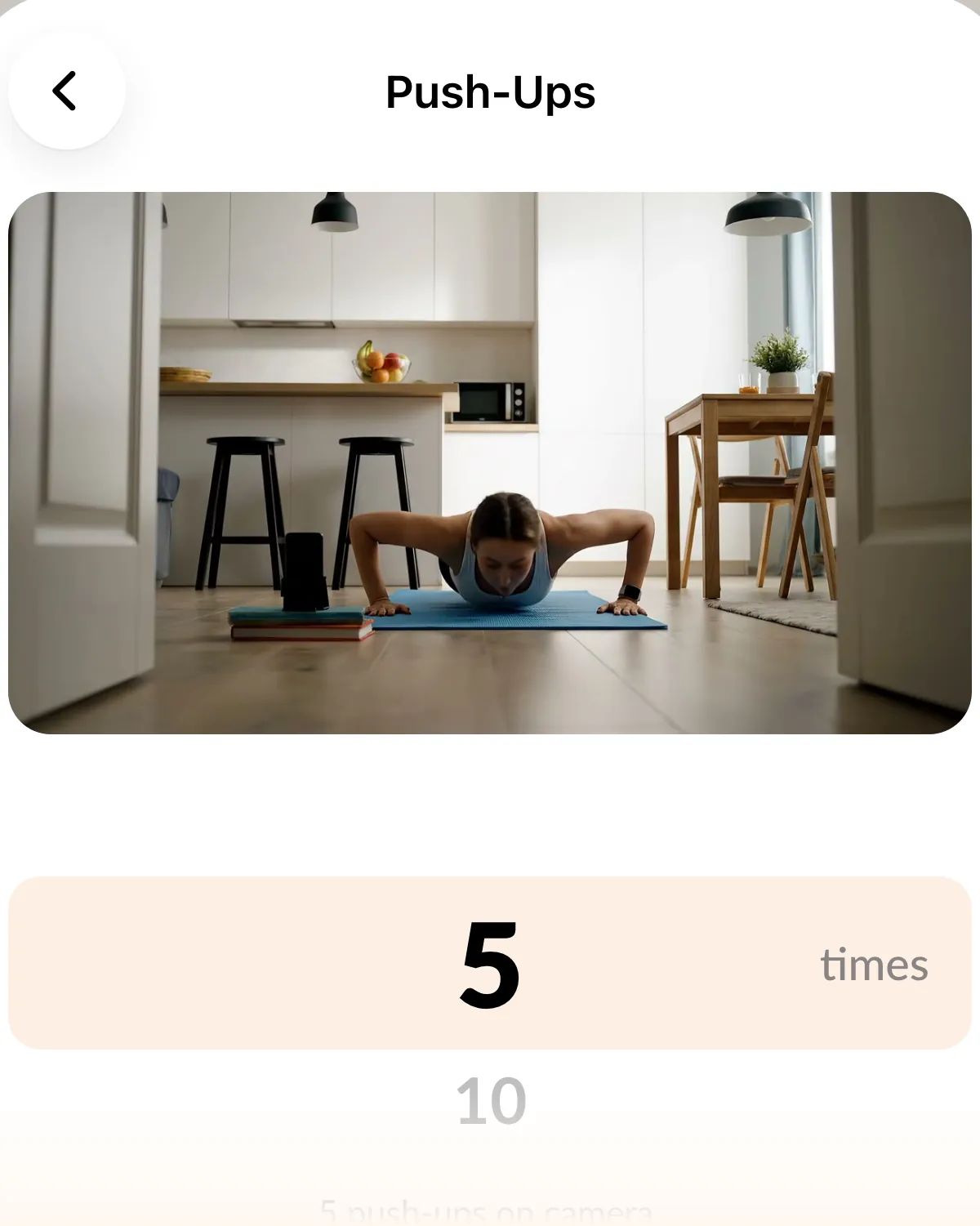
So start at 10 or 15. You can always creep up.
If you pick several missions, the app draws one at random each morning, so mixing movement with a mind game keeps it from turning into autopilot.
Safety first, briefly
This is not medical advice. A few common-sense notes:
- Clear some floor space before bed. Push-ups next to a nightstand corner are a bad idea at any hour.
- Do One-Leg Balance next to something you can hold. Balance is worse when you’re groggy.
- Skip the movement missions when you’re injured or ill, and pick a mind game instead.
- If you have a heart, joint or other condition, ask a clinician whether a burst of exercise right after waking is fine for you.
Other push-up alarms, fairly
We’re not the only ones who had this idea, and some of the others are good at it:
- Pushy counts push-ups and squats with on-device pose detection.
- PushClock is built around camera-checked missions and a strict no-snooze design, with every feature included in one subscription.
- Erly is also firmly anti-snooze (“No snoozes. No excuses”) and added live push-up counting to its Android app in September 2026.
Both PushClock and Erly need a subscription for full access.
Where we differ: every mission in Alarm Mate is free, movement included, and it’s the only push-up alarm we know of where other people get a say. You can wake up with a buddy doing their own mission at the same minute, or share a link and let a friend pick your mission and level.
If they choose Brutal, push-ups means 100, so choose your friends carefully (let a friend pick your alarm). If you want to try it, Alarm Mate is on the App Store for iPhone on iOS 26 or later.
For the other side of the morning brain, see why you turn off your alarm and don’t remember it. For getting up and walking without the push-ups, see the sky photo post.
FAQ
Do I have to do 100?
No. Push-ups and squats go from 5 to 100, and 5 is a perfectly good choice. The research above used a few minutes of light movement, not a max set.
Is my video uploaded?
Reps are counted on your phone, and the frames are not uploaded. The mission video is optional, and it only leaves your phone if you choose to post it.
Is it safe right after waking?
For most healthy people, a few push-ups or squats is ordinary movement. Clear the floor, hold on to something for balance work, and skip it when injured or ill. If you have a medical condition, ask a clinician first.
Sources
- Kovac K, Vincent GE, Paterson JL, et al. “The impact of a short burst of exercise on sleep inertia.” Physiology and Behavior 242 (2021): 113617. doi.org/10.1016/j.physbeh.2021.113617
- Beauchamps V, Sauvet F, Boyer S, Nemmi F, Buratto F. “Evaluate the effectiveness of cognitive stimulation and physiological dynamization on sleep inertia.” Frontiers in Physiology 17 (2026): 1855408. doi.org/10.3389/fphys.2026.1855408
- Kovac K, Ferguson SA, Paterson JL, et al. “Exercising Caution Upon Waking: Can Exercise Reduce Sleep Inertia?” Frontiers in Physiology 11 (2020): 254. doi.org/10.3389/fphys.2020.00254
- Hilditch CJ, McHill AW. “Sleep inertia: current insights.” Nature and Science of Sleep 11 (2019): 155-165. doi.org/10.2147/NSS.S188911
- Tassi P, Muzet A. “Sleep inertia.” Sleep Medicine Reviews 4 (2000): 341-353. doi.org/10.1053/smrv.2000.0098
Related posts
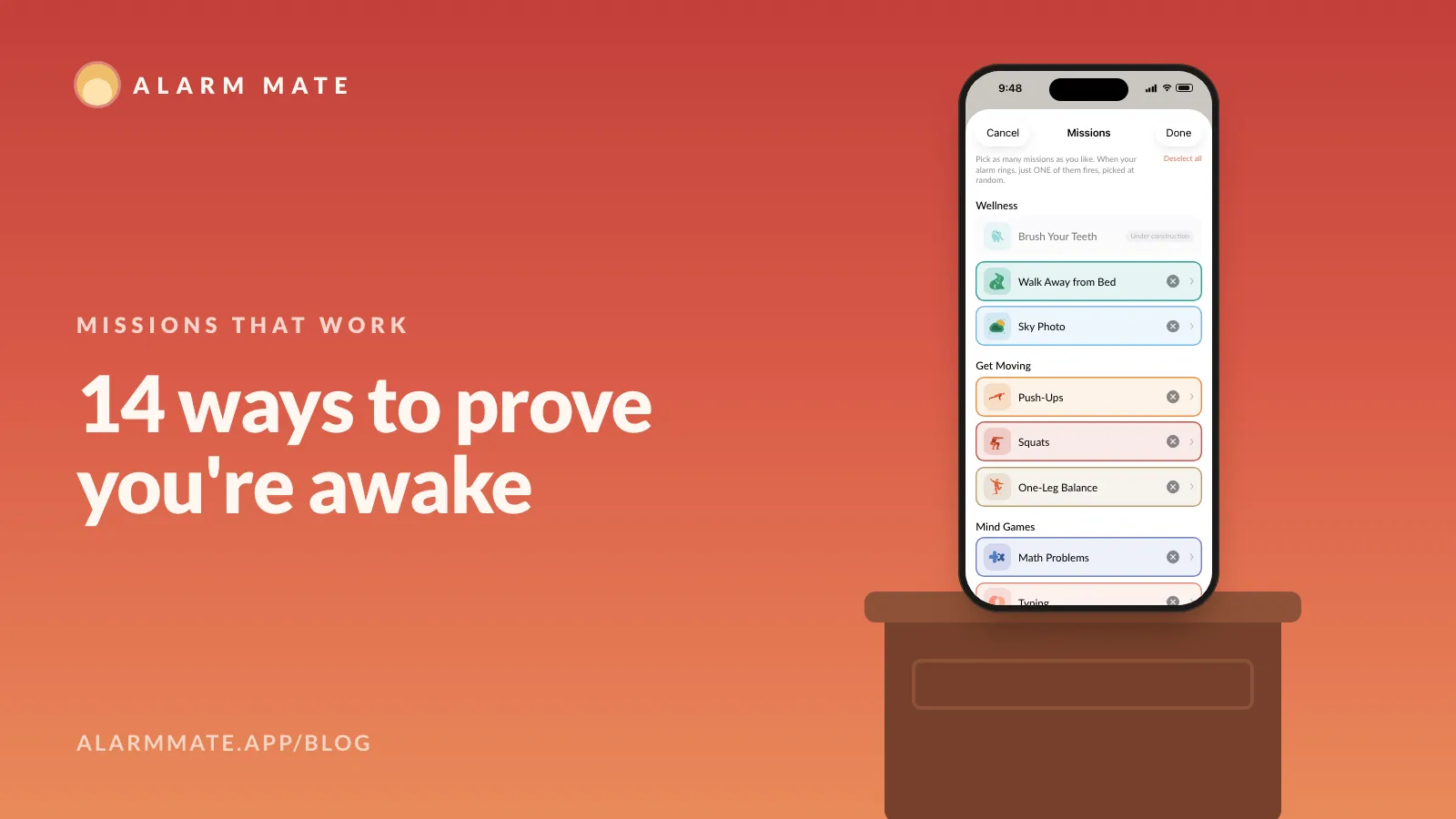
Alarm missions explained: 14 ways to prove you're awake
What alarm missions are, why the same one stops working after a week, and how 14 free missions get picked at random each morning on Alarm Mate.
Why you turn off your alarm and don't remember it
You probably did wake up. A 1997 sleep study shows how the memory can vanish when you fall back asleep, and which alarm tasks keep you up long enough.
Tomorrow morning, don't do it alone.
Alarm Mate is on the App Store for iPhone. Solo alarms are free, and so is every mission.